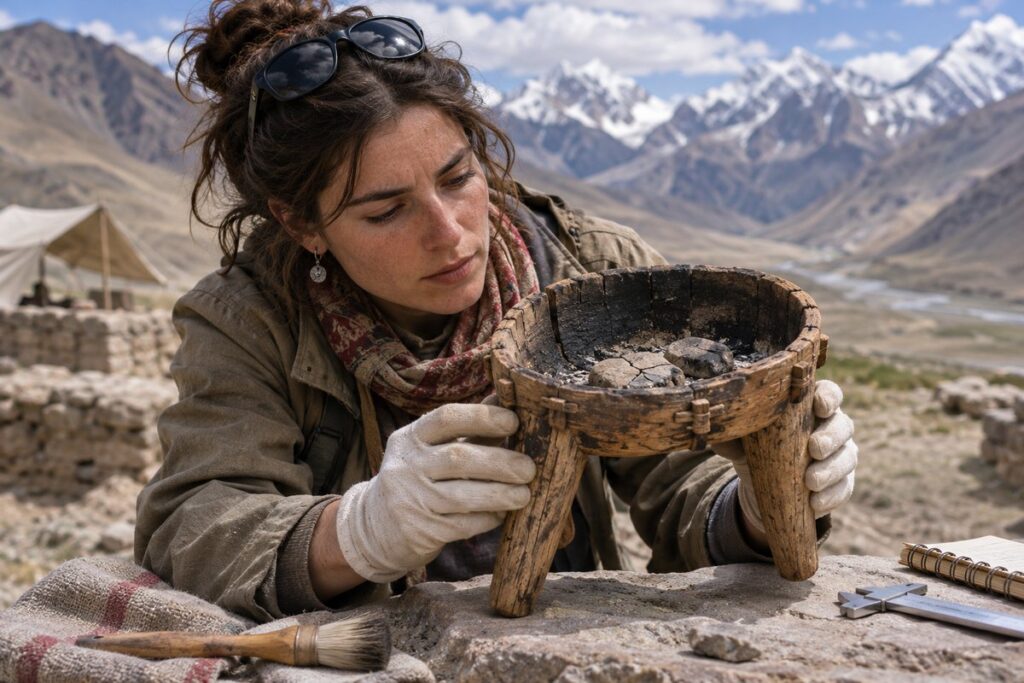
In the published inventory of objects from Jirzankal Cemetery, one wooden vessel appears twice. The sample numbered 8I came from its charred interior. Sample 8E came from the outside. The first yielded two chemical traces associated with cannabis. The entry for the second is a dash. Much of what makes the discovery persuasive lies in the space between those two lines of the table.
The vessel came from a burial ground high in the eastern Pamirs, in what is now western China. Around 500 BCE, people there placed wooden braziers in graves. Some held stones that had been exposed to heat. Blackened wood and burnt stones tell an excavator that something happened involving fire. On their own, they give no name to the material that burned.
A chemical trace on the side facing the fire
Meng Ren and colleagues sampled ten wooden brazier fragments and four burnt stones. Their report in Science Advances describes how they separated chemicals extracted from the objects and identified them by mass spectrometry. The most persistent clue was cannabinol, usually shortened to CBN. THC, a compound produced by cannabis, can give rise to CBN as it oxidizes. An ancient vessel may therefore retain a chemical relative of a compound that was present when the brazier was used.
CBN appeared on the charred interiors of nine vessels and on two of the stones. The exterior samples yielded no cannabinoids. Soil or handling might introduce a chemical onto a buried object, which is why the location of a signal is so useful. A pattern repeated on the surfaces facing the contents, with clear comparisons on the outside, fits an explanation involving what went into the vessels. The one interior without a detectable signal belongs in the account too. Archaeological preservation rarely produces ten identical answers.
What an ancient comparison sample adds
The team also examined preserved cannabis from Jiayi Cemetery, farther east. It supplied an ancient plant reference against which to read the brazier residues. Several cannabinoids remained recognizable in that material. The Jirzankal wood yielded a different pattern, dominated by CBN. The researchers argued that what had burned in the Pamirs was relatively rich in THC compared with many wild plants.
That interpretation is a comparison, with no percentage attached. Even modern experiments following cannabis samples over four years show that chemical composition shifts with storage conditions. An open fire followed by roughly twenty-five centuries in the ground is a much less controlled history. Back-calculating a fresh flower’s exact THC content from the surviving material would require information the vessels never recorded.
From the brazier to the burial ceremony
Other ancient finds illustrate how different evidence can be even within the same broad region. At Yanghai Cemetery near Turpan, researchers could examine surviving plant material directly, bringing botanical and genetic evidence to bear. Jirzankal preserves something especially valuable about an action: a plant-derived residue and the heat-marked surface on which it occurred. A bag of preserved material and a used brazier answer different historical questions. At the Judahite shrine at Arad, chemical residues turned up on the surfaces of altars. The setting gave archaeologists a different set of clues to interpret alongside the chemistry.
The placement in graves gives the burning a funerary context, and the authors interpreted the findings as evidence that people inhaled cannabis smoke during mortuary ceremonies. The chemistry has much less to say about who stood over a particular vessel, how many people attended or what the occasion meant to them. It can no more identify a participant’s experience than the stone can preserve the sound of a conversation.
Sample 8I thus carries a surprisingly detailed account for a piece of charred wood. The material, its location and the corresponding clean exterior support a particular use of the vessel. The dash beside 8E helps carry that argument all the way back to the fire. At the edge of the firelight, the people who gathered there remain largely beyond its reach.