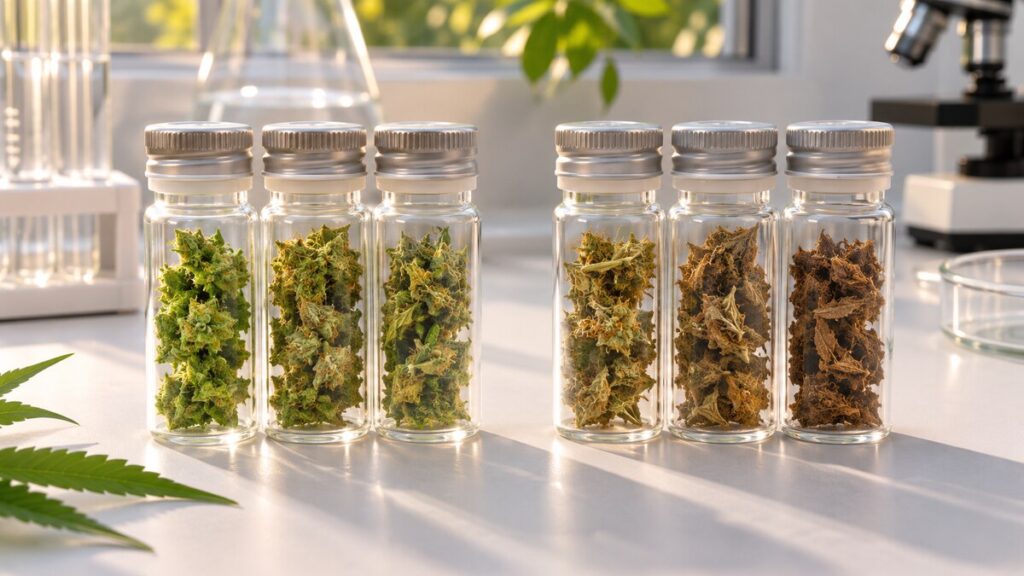
A scientist who wants to know what happens to cannabis over four years has an obvious obstacle: a four-year wait. Buying material described as four years old would be quicker, but the original chemistry would be lost. Was a low THC result caused by time, or did the sample contain little THC from the beginning? One research team chose to wait. The early measurements became the most valuable part of the collection.
Giving six products a chemical starting line
In a four-year study of cannabis flower and resin, Luca Zamengo and colleagues examined six products with different initial THC concentrations. They followed material under several environmental conditions and measured its chemistry over time. This arrangement separates two sources of variation that are inseparable in an anonymous old sample. The team knew where each product began, and it knew which conditions the material subsequently experienced.
THC is one of the compounds a chemist can track. Cannabinol, usually abbreviated CBN, can form as THC undergoes oxidative degradation. In the study, samples kept at room temperature showed a decline in THC and a rise in CBN over time. Cooler conditions produced different patterns. The simultaneous changes gave investigators more information than repeating a THC measurement alone. They also showed why it is risky to imagine that every calendar year leaves the same chemical mark.
Why the original number changes the comparison
Suppose one sample starts with twice as much THC as another. An equal drop of two percentage points represents a very different share of their respective starting amounts. Dividing each change by its own baseline makes comparisons of trajectories easier. But that simple arithmetic demands a baseline measurement. A forensic laboratory handed an unidentified sample years later will usually have only the end of the story.
Nor does a decline in THC require an equal gain in CBN. Material can undergo more than one chemical transformation. A measurement expressed as a proportion also depends on the rest of the sample. To establish that one substance turned quantitatively into another would require stronger evidence than two curves moving in opposite directions. The distinction matters when people try to treat CBN as a stopwatch.
Does a whole flower behave like an extract?
An early investigation by Fairbairn and colleagues compared cannabinoid solutions with herbal and resin samples under varying conditions. A solution and an intact piece of plant present rather different environments to their constituent molecules. An observation about one preparation therefore needs checking before it is used to predict changes in another. For example, a direct comparison of resin slabs and extracts found that the acidic precursor of THC degraded faster at room temperature in extracted material than in the resin. A label reading “cannabis sample” would have concealed an important experimental difference.
Tracking a wider chemical profile also changes what counts as a sign of age. A study of cannabis secondary metabolites after harvest examined cannabinoids alongside other constituents. A separate investigation of flower volatiles and cannabinoid content followed changes in compounds associated with aroma as well. A faded smell and a change in a THC measurement may both be real observations, but neither tells you exactly how much the other has changed.
Two different questions to ask an old specimen
A conservator with detailed records can ask how far material has departed from its documented starting state. An analyst receiving an unmarked specimen faces a more ambitious problem: working backward from present chemistry to an unknown past. The four-year experiment is especially informative about the first question. It gives the second investigator plausible histories to consider, some of which can lead to similar measurements.
The quiet achievement of the experiment is the series of dated observations between the first test and the last. A single reading can tell a chemist what is present within the limits of the method. Several readings on comparable material can show a direction, a rate and how the rate depends on circumstances. In that sense, the most persuasive marker of aging was never a particular molecule. It was the existence of a trustworthy earlier measurement.