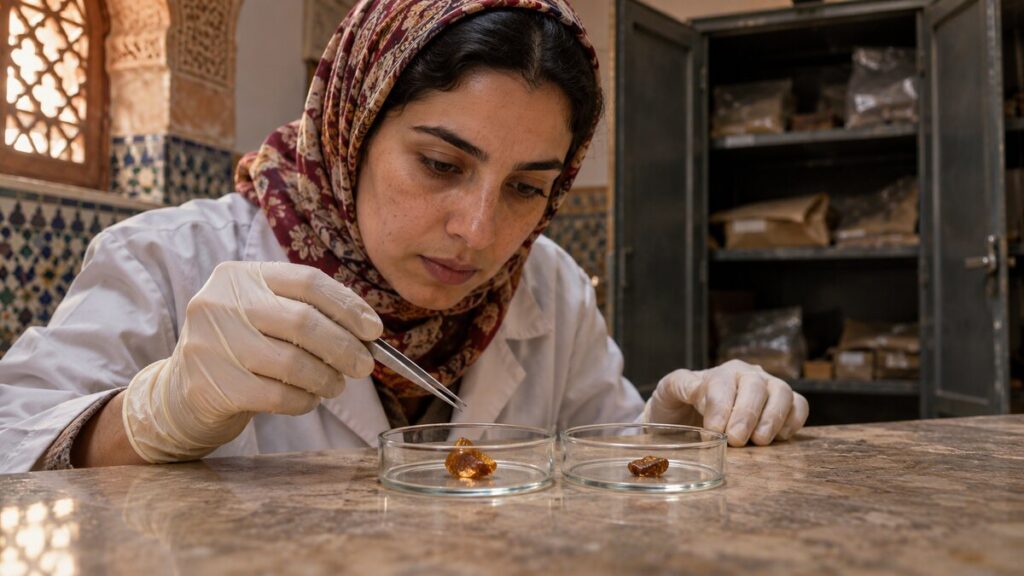
An evidence locker has two dates that are easy to confuse. One is the date a block of cannabis resin entered the locker. The other is the date the resin was made. The first can be recorded to the minute. The second may never be known. When researchers use chemistry to estimate the age of resin, the difference between those dates follows every prediction they make.
An archive with a known starting date
In a study of 150 resin samples seized in Morocco, researchers examined material from a collection dating to 2015. Thirty samples from the collection were selected for each of five groups representing successive two-year intervals, from the beginning of storage through eight years. The investigators could therefore relate chemical profiles to time in their archive. They did not have to assume that an unknown sample’s appearance revealed its age.
The groups differed in their measured cannabinoid profiles. THC was prominent in the initial group, and its concentration was considerably lower in stored material. Other measured constituents, including CBN, also varied. Those observations gave the researchers several chemical quantities to use when modeling changes over time. One design detail is important: a comparison between groups sampled at successive intervals is different from measuring the same individual block on all five occasions. Variation among blocks contributes to the picture.
What is a chemical clock supposed to read?
Suppose two blocks enter the locker on the same day. One had been made recently. The other had already spent a year somewhere else. Eight years later both have exactly eight years of documented storage. They may be different ages by any ordinary use of the word. Even a model that predicts the documented interval perfectly could give a misleading answer to a question about the date of manufacture.
The physical state could change before the evidence is logged. Research comparing resin slabs with extracts found different rates of chemical change in the two preparations. The physical surroundings matter too. In a separate experiment following cannabis products for four years, cannabinoid changes differed across storage conditions. Two samples with matching chemical profiles might have reached them at different speeds. If you have ever tried to tell how long a cut apple has been on the table from its color alone, you already know the shape of this problem. Useful clues can coexist with several plausible histories.
How to challenge a promising model
A model takes a set of measurements and produces an estimate. The first question concerns fit: does the proposed relationship describe the observations from which it was derived? A harder question is prediction. How closely does the relation estimate the documented storage time of material whose dates were kept hidden until after the estimates were made?
The strongest test for a broad claim would include resin from an independent collection, with different starting compositions and documented histories. Withholding some observations from the original archive would test the model under more familiar conditions. Both tests are useful, but they probe different uncertainties. A prediction for an entirely new collection should also indicate its range of error. An answer of “four years” sounds very different if the plausible range is months rather than several years.
A ratio removes only one kind of uncertainty
Earlier investigators examined the ratio of CBN to THC as an indicator of storage age. A ratio can reduce the influence of a factor that multiplies both quantities equally. It cannot recover the original ratio of an unknown block. And when the denominator becomes small, modest analytical variation can move the ratio sharply. Broader experiments on the stability of cannabis preparations give good reason to keep a specimen’s physical history in view.
For an archivist, the strongest use of the chemistry may be to investigate a discrepancy. A specimen looks unusual for its documented time in one collection. Its records, packaging history or starting composition may warrant a second look. That is already information an ordinary calendar could never provide. The chemistry becomes much less dependable when asked to supply a precise birthday for a block whose life before the locker remains unknown.